

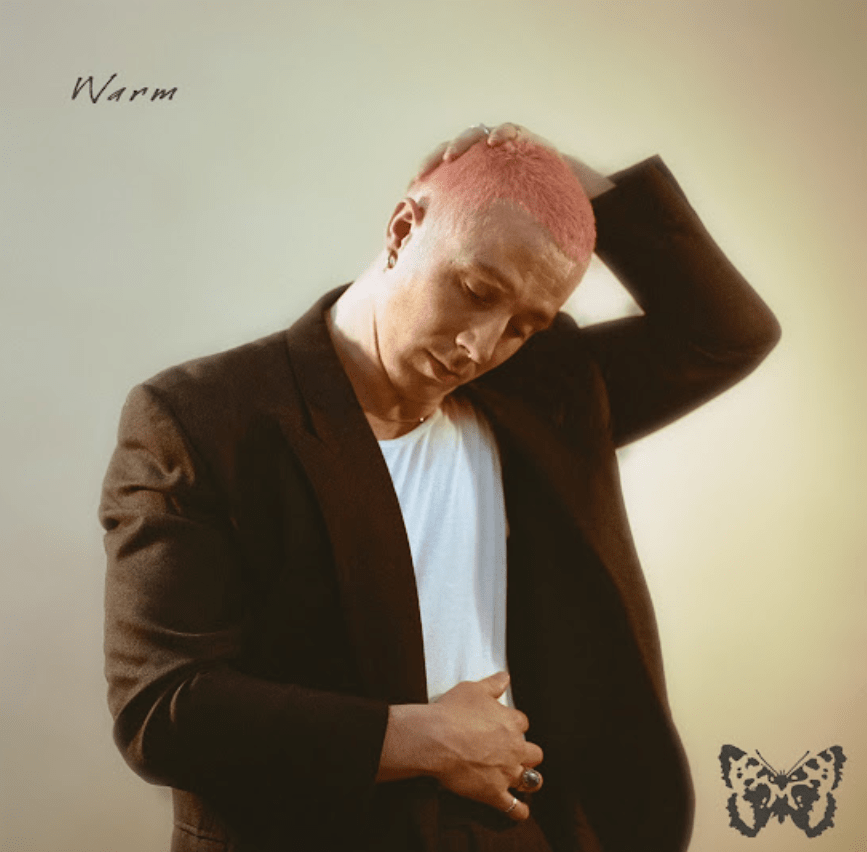
As a first release from Moncreiff’s upcoming EP, ‘Warm’ is a hugely promising start to the next musical chapter expected from the London-based Irish singer/songwriter. The song is an anthem showing how one person can overlook your flaws and make you want to be a better person while still maintaining the intimacy and soul of an intimate, heartfelt ballad which is a feat in and of itself. It exemplifies the concept of raising the ordinary to extraordinary.
After hearing ‘Warm’ for the first time last year during a Livestream performance, we knew this song was special. As we felt it brought Moncrieff’s work to another level and we knew once it was finally released we needed to do something special, this resulted in us not only including a review of our thoughts on ‘Warm’ but in us reaching out to Moncrieff to ask him a few questions on his writing process, the song itself and his connection to his fans.
What is the key to creating a song like this? Is there a method to how you write your music?
Moncrieff: I’ll start the second part first. Is there a method? Not particularly. I think sometimes songs might start as a melody in your head with no lyrics. Sometimes, songs start as a phrase, like a certain phrase that keeps going round and around your head, and music happens to that and then, sometimes, songs just start as a little riff that you have in the piano or that guitar. So, no. It’s usually one of those three things and is about whatever, either something that is happening in your life or has happened in the past that’s messed you up. What is the key to creating a song like this? I feel like – I don’t know. What I like about this song is I think the song – what I’m quite proud of is that we managed to make the small things huge which is something I’ve always wanted to try do and I feel like – by that I mean, you know, even the sound of rain on a roof these are the moments that, I dunno become so important and are huge in our minds but on the surface, at first glance, aren’t very big. So I think that’s what Warm has kind of managed to do.
As a writer, what aspects of life inspire you most? Is it those moments of high emotion, is it the everyday things or is it a combination of both?
M: I think the moments of high emotion and the everyday things, in a weird way for me, are kind of combined. Take Warm for example, it’s a very high emotional song but it’s based in the most simplest of things and, for me, if I’m going to write about something and it does have to have high emotional value to it but a lot of the time most of those things are built up in moments that are very small that all culminate in what is a huge thing for me.
We’ve seen from this and previous releases (The Class of 2020) that your music has powerful messages to share. If you could describe the message of this song very briefly, what would it be?
M: That if you find somebody that truly sees you for you, all your flaws and imperfections, and loves you for them regardless then hold onto that person with all your strength because that’s a very rare thing.
With Warm being so hopeful and so full of positivity, is there any particular lyrical aspect of the song you really feel captures the full message of the song as a whole?
M: This is an interesting question because for me there’s a secret- on the surface there is an on the surface sort of message but there is a secret sort of message and a secret meaning hidden in the actual song itself and it’s hidden, for me personally, in one particular lyric, well a combination of – it depends whether you look at it as one or two. Sooo I don’t really want to give that part away. I think it’ll mean what it means for different people but, for me, there is an extra meaning hidden aaand I’m not going to tell you where. But yeah, let me know if you find it.
The introduction of the choir during the second chorus inspires this feeling that the person you’re singing to is almost angelic. Would that be an accurate representation of what you were aiming for? And what helped you decide to produce the chorus as you did?
M: Yeah, well I mean it’s a combination of things. I think that somebody who does see you for you – these kind of people are f*cking angels, you know? And they are real life angels in the world and so I think I felt like going down a bit of a gospel-ly route would help especially because there are those elements of self-forgiveness and self love there and I’m not a particularly religious person but I feel those kind of feelings as well. So, yeah, it all kind of came in a natural way. And I love doing backing vocals so I did them all which was really fun.
So as an introduction to your upcoming EP, Warm seems very hopeful; can we expect more music of a similar vein within your EP or is it a variety of topics and emotions that we can expect from you?
M: I feel like this EP is the closest I’ve got to having a body of work that really feels like a real overall message and I’m really proud of it. But, yeah, it deals with – I’m glad you said hope because hope is the main vein. It is about hope and the next single is very hopeful as well but it’s not necessarily… Hope isn’t necessarily a super happy thing. Hope can be the last thread that you hold onto when you are in the darkest of places. But definitely hopeful. I agree that’s where it’s going to be.
Compared to previous releases, Warm seems far more descriptive, detailed focused and almost poetic; there is an almost story-like quality to the song but is this a new writing style that you intend to follow on with in future releases or is it one of a one off approach for this particular song?
M: I don’t know. I feel like I think so. I think as I’ve gone more personal with this body of work and kind of returning back to where I began making songs with songs like ‘Like I Do’ I think… a bit more descriptive and going back to the first question I like the idea of focusing on the small things and magnifying them emotionally and magnifying them as things and try dissect them. I guess that is descriptive and detailed focussed. I don’t really keep tabs on how my writing style goes but, I guess at the moment, it feels like that.
Do you create your own music with the intention of reaching people emotionally or is it created, in a sense, for yourself as a kind of therapeutic way of dealing with personal things and then just shared with others? Continuing on from that, how does it feel knowing that your music and what you’ve created resonates in such a huge way with your audience?
M: I initially began making music as a means of processing emotions that were kind of threatening to overwhelm me when I was a teenager and I had no avenue to express those things. Music was that and it wasn’t made for commercial value or anything. That’s how it started and it helped me. It got me out of such a terrible place and I think coming out of the back of that – I obviously still have bad days – but coming off the back of that when I decided that I wanted to make my music my life was that I wanted to take that journey and I understood that everybody, to a certain extent, is going through that journey and I want my music, my story through my music, to be some sort of help. To show something that people can relate to and to show that we’re not really alone. So yeah I think the best way of trying to help people is to sing about your own stories and, hopefully, people can connect to that. Otherwise, sometimes it can feel a bit preachy.
Through livestreams on social media, it’s apparent that you’ve generated more confidence and become more comfortable exploring and discussing the topics that you’ve written about. How does that influence the way that you approach songwriting if it does at all? Has this connection with your fans also influenced the topics that you’re willing to broach in your music? Does this connection offer you more freedom with what you write and what you can consider a safe topic with your fans?
M: It doesn’t really have that much of an effect if I’m going to be honest. The lives are just kind of fun for me and it’s a great way to try out new songs, like you said build some confidence and kind of get closer to the people that really f*ck with your music, you know? Because that’s what I love. I love my family- my gang- and I really, really find it important to look after that and nurture that because that’s what it’s all about. These are people that my songs mean something to. I don’t think it really- not consciously – affects my song writing because I’m kind of a person that the less time I spend on social media the better because I just don’t like looking at my phone all the time. I think it’s just a cool thing and it can be fun.
Single Review
Filled with detailed memories and secret moments, ‘Warm’ transports the listener to their own intimate moments with the person they hold dear or have held dear. On the surface, ‘Warm’ tells the story of finding that one person who truly sees you for you despite all of your flaws and self-perceived downfalls yet still loves you. But, to me, it also is an ode to that one person who you allow your walls down for, the person that knows you better than you know yourself.
‘Warm’ opens very simply: a man and his piano with a message to get across. There are no unnecessary frills and this adds to the intimacy of the song. This simplicity allows you to focus on what Moncrieff and his team do best, which is lyrics. Moncrieff also has such a unique voice and falsetto that conveys so much emotion and vulnerability in this opening verse and chorus and draws in the listener with such brutally honest lyrics. He admits ‘I’m so far from perfect’ which just highlights the humanity of the song which is underpinned by the music and production. The introduction of the drums and percussion brings up the tempo of the track, building on the positivity of the lyrics. The inclusion of a choir and rhythmic clapping in the second chorus only adds to the positive, hopeful, almost uplifting feeling the song gives to the listener and instills a very real sense of warmth. It is nigh on religious in its own way yet maintains the humanity and reality of relationship. The choir, however, doesn’t dominate the chorus but rather emphasises specific aspects of the lyrics. Lyrics like “so far from perfect” and “coldest of nights” are given emphasis and, when you focus on the lyrics that are given this choral emphasis, they are in essence negative but given positive connotations when coupled with the gospel tone of the chorus. I’m not usually one to point out lyrics but there is a wonderful juxtaposition between ‘And I’ll always be heartless’ and ‘it’ll always be yours’ that I just have to point out. Heartless is such a negative expression, suggesting an unfeeling and uncaring nature, but to imply that you’re heartless because you’ve given your heart to someone else reveals what sounds like a hopeless romantic under that negative opinion of one’s self. At its very core, if you stripped away all the production, ‘Warm’ is an exceptionally human song and honest to a fault. With the production included, it emphasises the wonder and hope that one person can instil in someone; possibly someone who didn’t have much hope to begin with.
From a literary perspective, Warm makes fantastic use of detailed imagery created through its lyrics and introduces poetic devices like hyperbole, rhyming and meter. To fully dissect the song from a poetic point of view would take a long time so I will focus solely on the best examples of each and the impact they have. Using poetic devices, we, as the listener, receive extremely detailed mental images and it is because of the writing style that has been adopted that we can gain this. Because of how the song was put together and phrased, we can also understand the importance of the person that the song is written about because clearly the smallest things are as important as the most important information that he will learn about this person.
The rhyming scheme and tempo/rhythm/time signature of the song are common in music but they do, however, create this sort of comfort because they’re so familiar. It inspires this sense of comfort based on how he’s built the song and then how he rhymes the song. We, as listeners, feel safe and feel warm inside a sort of comfort blanket that is the familiar. But, in discussing rhythm and meter, we do have to look at one particular aspect of the song where the rhythm and lyrics become in a way syncopated, it may be just my ears but it sounds like a change of time signature or tempo (don’t quote me on any of this, I’ve a very limited knowledge of sheet music and time signatures) which highlights a concept that is at odds with the hopeful theme running through the rest of the song. This occurs with the lyrics “And I know that we’re so far apart, I see your face when I look to the stars Oh I” and then returns to the usual tempo/time signature for the chorus.
So, in regard to hyperbole, there is this concept that everything, even the smallest thing, is greater than what it is and one prime example of this is the fact that, in his lyrics, he equates the subject of the song to someone who can wash away his sins, his flaws and his faults making them seem almost angelic raising the subject’s status from that of a mortal to an angel (once again raising the ordinary to the extraordinary). Moncrieff has managed to raise even the most insignificant thing to something that is truly extraordinary. It is this attention to minutiae that makes this song seem so important and through this hyper fixation on seemingly insignificant details, we find ourselves focusing on a detailed mental image with no specifics. We know nothing about the physical appearance of the person but we know so much about this person solely because of the writer’s attention to detail. We know about the time spent with this person and how they smile. All in all this song, though hopeful on the surface, does seem bittersweet underneath and after really focusing in on details has me wondering if this person is still in Moncrieff’s life. They, whether they are still present in Moncreiff’s life or not, clearly made a huge impact without a shadow of a doubt and have taught him that self-love and self-forgiveness are important in being the best possible version of yourself.
Another set of lyrics I personally loved the imagery of was “I know that we’re so far apart, I see a face when I look to the stars” in comparison to “on your coldest of nights babe, I’ll be there keeping you warm”. As always, songs are also open to interpretation by the listener. For me, it made me think of ‘Warm’ as not only a song to someone who loves you for you romantically but also about someone who loves you for you in a platonic way. With these lyrics, it made me feel that the person may no longer be in your life but, looking back on the memories, what you learned from and about one another will keep reminding them and yourself from afar that you are worthy of everything good that comes your way.
As a final note, because we love looking at symbolism (not only in the lyrics and music of the song but in the artwork attached to it), we also enjoyed the inclusion of the butterfly on the single cover. The obvious symbolic meaning of a butterfly is rebirth but the less commonly known meaning is hope which ties into the hope aspect of the song nicely. It subtly ties the artwork to the theme of the song in a simplistic but effective way.
We would like to thank Moncrieff for agreeing to answer our questions and taking the time out of his schedule to sit down and answer them with such detail. ‘Warm’ is out now and available on all good streaming platforms.
“And all these little memories, they play me like a melody. But I don’t want the song to end. It belongs to you and me.”
 Our Muchness Guide
Leave a comment